


Subcutaneous parasites are represented by various types of living organisms.These are bacteria, protozoa, worms, insects.Many people can live peacefully for a long time without knowing that parasites are present in their body.In the meantime, they will reproduce and increase their population.The activities of foreign agents can have serious consequences.Subcutaneous parasites cause various symptoms, inflammatory processes of the skin and intoxication in humans, which in turn provoke disruptions in all body systems.Some representatives of the skin parasites are disease carriers.
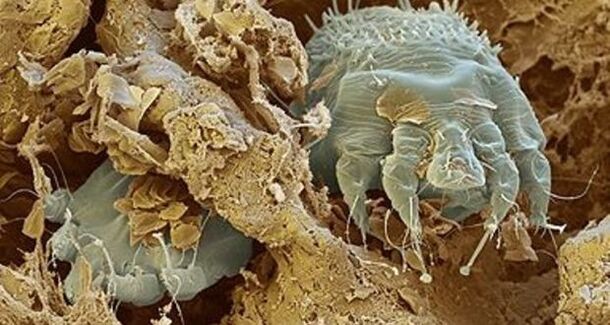
Known parasites and their activities
Parasites are transmitted to humans from other people, through water, contaminated meat and from pets.Parasitic skin diseases of different types have different degrees of danger but similar manifestations.In order to recognize an infection in time, you need to know the most important pathogens.They form three groups:
- Worms.Roundworms (filariosis, dracunculiasis, gnathostomiasis), flatworms (schistosomiasis).Worms live not only in the intestines, but also under the cover of human skin.
- Mites (scabies, demodicosis).Skin mites vary in shape and are microscopic.
- Insects - fleas, flies (myiasis, sarcopsillosis).
The doctor determines the type of parasite in the skin and the degree of infection.The treatment is also prescribed by a specialist;No independent action can be taken.
Filariasis
Filaria have a second name – filaments.These are thin worms that can reach a length of 45 cm.They parasitize under the skin, in blood vessels and in the heart.Filariae are the most unpleasant parasites in the human body.You can become infected with the infection in countries with a hot tropical climate.The disease is transmitted by blood-sucking insects.The invasion does not manifest itself immediately;The incubation period is up to 7 years.All this time the worms are actively multiplying.When the number of parasites becomes enormous, a person begins to feel the consequences of poisoning the body.A small red rash and severe itching appear on the skin.As the disease progresses, the following symptoms appear:
- visual impairment;
- mobile seals under the skin (these are moving worms);
- Fever.
Filariasis can be diagnosed with a simple examination.After an accurate diagnosis, the doctor prescribes the necessary treatment.To avoid infection with filariae, you must be vaccinated before a vacation trip to tropical countries.
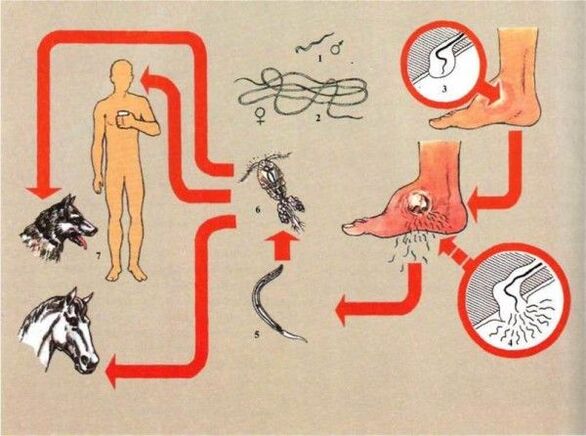
Dracunculiasis (Guinea worm)
The rarest parasitosis in our latitudes.Dracunculiasis is caused by the female nematode Dracunculus medinensis.You can become infected with parasites through water.The worm enters the human body, gnaws through the intestinal walls and enters the body cavity through the lymphatic system.Skin parasites mostly live in a person's lower extremities and can reach a size of one meter.The disease is manifested by itching in the legs, roller-shaped tumors, ulcers on the skin and large blisters bursting from the water.
Schistosomiasis
The tropical disease schistosomiasis is caused by trematodes.When parasites invade the body, symptoms of dermatitis appear.Then there is an allergic reaction to the waste products of the parasites, which manifests itself in a skin rash, fever, swelling and increased night sweats.Schistosomiasis can lead to disorders of the intestines, genitourinary system and liver.
Gnathostomiasis
The causative agent of the disease is Gnathostoma larvae.People become infected with worms when they eat fish and poultry meat that has not been adequately heat treated.Gnathostomiasis is common in countries with a tropical climate.A helminth infestation is manifested by the formation of nodules under the skin.The larvae of the parasite can cause eosinophilic meningitis, eye damage, skin swelling and diseases of internal organs.
scabies
50% of the population has experienced scabies at some point in their life.Its pathogens are ticks.The main symptom is severe itching of the skin.The disease is transmitted through contact.In humans, scabies mites are located on the hands and joints.In the initial stages, it is difficult to diagnose parasites on human skin.After a certain time, the movements of ticks gnawing through become noticeable.Constant scratching causes blisters to appear on the skin.
Demodicosis
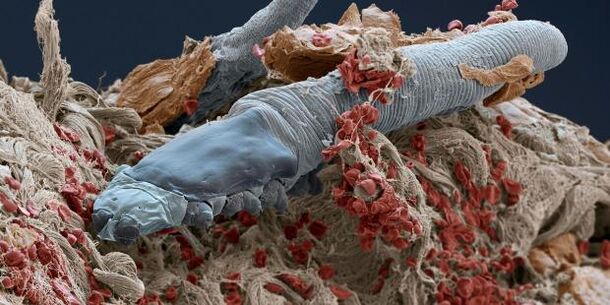
Demodicosis is caused by permanent residents of the human sebaceous glands - Demodex mites.With weakened immunity, parasites begin to actively multiply.Symptoms of demodicosis:
- redness;
- Itching;
- Acne;
- white crusts on the eyelashes (demodex of the eyelids).
To diagnose demodicosis, a curettage is performed to look for parasites.The disease is chronic and worsens in spring and autumn.You cannot become infected with demodicosis;The causes of the disease lie inside the body.
Miaz
The disease is caused by fly larvae of 18 species.Eggs are laid by insects in wounds or on healthy skin.The larvae destroy adjacent tissue and blood vessels by eating them.The vital activity of insects leads to the formation of ulcers, abscesses and local hemorrhages on the skin.
Sarcopsillosis
Sarcopsillosis is common in tropical countries.It is caused by fleas and usually affects the legs.A painful lump and itching appears where the flea has entered.The surrounding tissue becomes inflamed.The infection can lead to gangrene and blood poisoning.
Diagnosis of parasite infestation
Severe and regular itching of the skin is a sufficient reason to see a dermatologist.You also need to consult an allergist and infectious disease specialist.After an initial examination and anamnesis, the diagnosis is made using two specific laboratory methods:
- Direct methods.Definition of a parasite.A scraping, samples of the epidermis or iron secretions are taken for examination under the microscope.
- Indirect methods.Determination of antigen-antibody complexes.Blood is taken, an enzyme immunoassay, an indirect hemagglutination reaction or a complement fixation reaction is carried out.
If no subcutaneous parasites were found in a person, neurological and psychosomatic disorders may be the cause of itching.Then you need to consult a psychotherapist.
When the parasites living under a person's skin and their concentration are accurately determined, the doctor prescribes appropriate treatment.

Treatment of skin parasites
Depending on the type of parasite, parasitic skin diseases can be treated conservatively or surgically.
- Filariasisbe treated in hospital with an anthelmintic.In parallel, antihistamines and anti-inflammatory drugs are prescribed.Types of filariasis such as onchocerciasis and brugiosis are treated surgically.
- Dracunculiasissurgically removed.Oral antihistamines are also prescribed.If you have dracunculiasis, you must definitely get vaccinated against tetanus.
- Schistosomiasisbe treated with anthelmintics in hospital.To treat Japanese schistosomiasis, antimony preparations (Brechstein-Brechstein) are used.
- pathogensGnathostomiasisbe removed surgically or with an anthelmintic from the benzimidazole group.
- scabiesTreated at home with sulfur ointment, a special drug.The products are applied in a thin layer to the affected areas.For prevention, the measures should be carried out by all family members who have had contact with the patient.
- Get rid ofDemodicosispossible with the help of antibiotics, local acaricides, antihistamines and anti-inflammatory drugs.
- Larvae that provokeMyiasis, surgically removed.The wounds are then treated with an antiseptic solution.
- Sarcopsillosismust be treated surgically.
The duration of treatment depends on the type of parasite and the degree of infection.If the action of foreign agents disrupts the functioning of other organs and systems, special treatment is prescribed.
Prevention of parasitic skin diseases
It can be difficult to identify subcutaneous parasites in humans.The treatment takes a long time.To avoid undesirable consequences, you need to take preventive measures.
- Vaccination.Before traveling to tropical countries, you must be vaccinated against parasites.
- Thermal treatment of meat.Pork is heavily infested with helminths;it must be completely fried or baked.It is better not to eat sushi in dubious establishments, as they may violate the storage conditions of the fish.
- Processing of vegetables and fruits.
- Cleansing and boiling water.
- Protection against blood-sucking insects.When you go on vacation, you need to take closed clothing and mosquito and tick repellent with you.
- Compliance with personal hygiene regulations.
- Regular self-exams.Parasitic infestations under the skin are often visible to the naked eye.
- Regular medical examinations, twice a year.
Simple rules will help you maintain your health and protect yourself from subcutaneous parasites.
Parasites under human skin are uninvited guests that can seriously harm the life of the owner.Only timely detection will help to fully recover.You need to pay attention to the body's signals to recognize signs of infection.